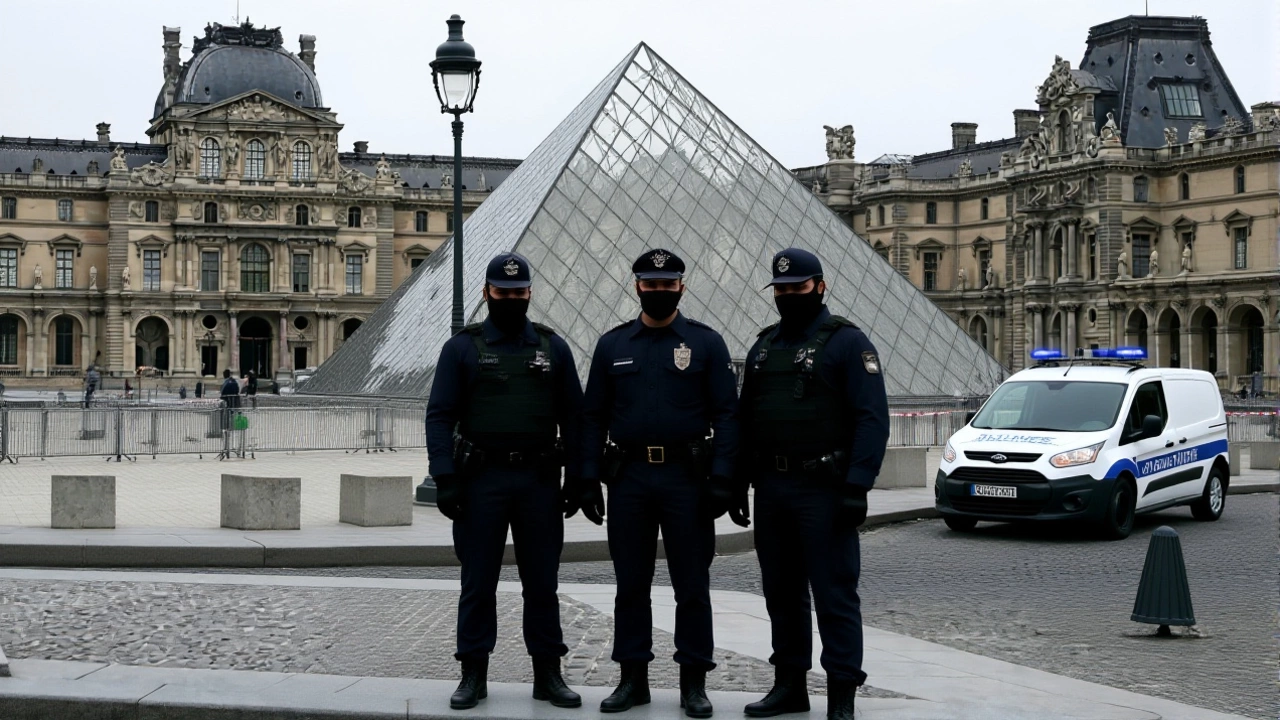
On November 25, 2025, French authorities swept through the Paris metropolitan area and detained four more suspects in the audacious October 19 heist of imperial jewels from the Louvre Museum, pushing the total number of arrests to eight. The newly arrested individuals — two men aged 38 and 39, and two others aged 31 and 40 — all live in the Île-de-France region, according to the Paris prosecutor's office. The heist, which stunned the global art world, remains unsolved: eight priceless pieces of 19th-century royal jewelry are still missing, and the public is left wondering where they’ve vanished.
The Heist That Shook the Louvre
At 9:30 a.m. on October 19, 2025, four men dressed as construction workers rolled up to the Galerie d'Apollon in the heart of the Louvre Museum, mounted a mechanical ladder to a second-floor window, and slipped inside during peak tourist hours. In less than eight minutes — just four of them inside the gallery — they shattered display cases and made off with nine items, including a crown once worn by Empress Eugénie de Montijo. That crown was later found abandoned near the exit, a careless mistake that left investigators with a critical clue: the thieves were in a rush.
The stolen pieces? A breathtaking collection from France’s imperial past: the sapphire tiara and necklace of Queen Marie-Amalie; the emerald necklace and earrings from Empress Marie Louise; and the reliquary brooch, corsage bow brooch, and tiara of Empress Eugénie. According to the French Ministry of Culture, these weren’t just valuables — they were national heritage, documented in the Louvre’s inventory since the 1800s.
International Manhunt and the Missing Millions
Valuations vary wildly. France24 reported the haul was worth $102 million USD. French government sources, cited by Wikipedia, pegged it at €88 million EUR. Either way, it’s one of the most valuable art thefts in modern European history. INTERPOL added the items to its global Stolen Works of Art database on October 20, 2025 — a move that triggered alerts to 195 member countries. The agency’s Lyon headquarters issued a public poster with detailed images, urging anyone with information to come forward.
The first wave of arrests came just days after the robbery. On October 25, two suspects were nabbed — one caught at Paris Charles de Gaulle Airport trying to board a flight abroad. Five more were detained on October 29, but three were released within hours. Only two were formally charged by October 31: a 37-year-old man accused of theft and conspiracy, and a 38-year-old woman charged with organized theft. Both denied involvement.

Security Failures and the Silent Panic
It was the first major theft at the Louvre since 1998, when a single painting vanished. That 27-year gap bred complacency. The museum, which welcomed 10.2 million visitors in 2024, had relied on visible guards and glass cases — not the kind of layered, tech-driven security you’d expect at a site holding such treasures.
In the days after the heist, the French Ministry of Culture quietly moved dozens of other high-value jewels from the Apollo Gallery to the fortified vaults of the Banque de France in central Paris. The move, confirmed by an internal memo dated November 20, 2025, spoke volumes: even the state didn’t trust the Louvre’s security anymore.
The New Arrests and What’s Next
The four suspects detained on November 25 are currently held at the Paris Police Prefecture headquarters on Place Louis Lépine. They’re not believed to be the actual thieves who broke in — investigators suspect they’re part of a support network: fenceers, drivers, forgers, or insiders who knew the museum’s routines. One suspect from the October arrests is still at large, and prosecutors won’t rule out more arrests.
What’s striking is the precision. The thieves knew exactly which cases to target, how long to stay, and when the security patrol would turn the corner. This wasn’t a random smash-and-grab. It was a job. Someone inside — or with inside knowledge — gave them the blueprint.
Why This Matters Beyond the Price Tag
These aren’t just jewels. They’re tangible links to France’s imperial identity — worn at coronations, gifted to allies, buried in private vaults after the fall of the monarchy. Their disappearance isn’t just a financial blow; it’s a cultural wound. Museums worldwide are now re-evaluating how they display their most sensitive artifacts. Should they be locked away? Digitally replicated? Or is the public’s right to see them worth the risk?
For now, the Louvre’s doors remain open. But the Apollo Gallery, once a glittering crown jewel of the museum’s collection, is now a hollow space. A single glass case sits empty, marked only by a small plaque: “On loan — temporarily.”
Frequently Asked Questions
How were the thieves able to get inside the Louvre undetected?
The thieves exploited a known blind spot: the Galerie d'Apollon’s upper-level windows, which were historically left unmonitored by motion sensors to preserve the room’s aesthetic integrity. Surveillance footage shows them using a ladder mounted on a van parked near the Rue de Rivoli entrance, bypassing ground-level guards entirely. The museum’s security system had not been upgraded since 2019, despite repeated internal warnings.
Why is the value of the jewels so disputed between sources?
Insurance valuations differ from market estimates. France24’s $102 million figure includes speculative auction prices for comparable royal jewels, while the French government’s €88 million estimate reflects official replacement costs under cultural heritage law — which often undervalues items that can’t be legally sold. Many of these pieces are irreplaceable, making any dollar figure inherently incomplete.
What happened to the crown that was left behind?
The Empress Eugénie’s crown was recovered near a service exit, its diamond pins bent and one sapphire missing — suggesting it was hastily removed from its display case and dropped in panic. Forensic teams found traces of silicone gloves and a rare French-made cutting tool on its surface, which may help link it to one of the suspects. It’s now in secure storage at the Louvre’s conservation lab, under armed guard.
Are any of the suspects connected to previous art thefts?
Yes. One of the suspects arrested on October 25 had a prior conviction in 2019 for assisting in the theft of a 19th-century pocket watch from the Musée d’Orsay. INTERPOL’s records show a pattern: he worked with a known network of French and Belgian art traffickers who specialize in royal collections. This suggests the Louvre heist may be part of a larger, organized ring targeting Europe’s most iconic museums.
Could the jewels be in Russia or Eastern Europe?
It’s a leading theory. Russian oligarchs and private collectors have long been linked to untraceable acquisitions of imperial Russian and French artifacts. INTERPOL has flagged several luxury properties in Monaco and Geneva as potential transit points. But no concrete evidence has surfaced yet. The thieves may have disassembled the pieces for resale as raw gems — a common tactic when items are too recognizable to sell whole.
Will the Louvre ever display these jewels again?
Unless they’re recovered, probably not. The museum has already begun planning a new exhibit: "The Empty Cases," showcasing the absence of these pieces with digital reconstructions and archival footage. It’s a quiet protest — and a warning. Some curators argue the jewels should never be displayed again, even if found, to prevent future targeting. The debate is just beginning.